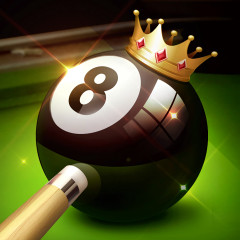
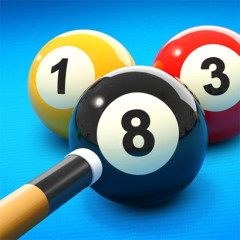
8 Ball Billiards offers a thrilling billiards experience with smooth ball-hitting mechanics. Use strategic thinking to win against tough opponents.
Rules of 8 Ball Billiards
Your objective is to pocket all of your group of balls (striped or solid) before your opponent. After pocketing all of your group of balls, pocket the 8-ball legally to win. During the game, you need to aim accurately, control the force of your shot, and position the cue ball to create favorable positions for subsequent shots. After successfully playing, you can try Solitaired to hone your skills.
Ball Groups: Solid & Striped, with 15 balls on the table:
- Solid balls (1-7)
- Striped balls (9-15)
- 8-ball (black ball & the ball that determines the winner)
After the first legal shot that pockets a ball, the player will be assigned either the solid or striped group.
Game objective
- Pocket all of your group of balls before your opponent.
- Finally, pocket the 8-ball legally to win.
Turns and fouls
You lose your turn or are penalized when:
- Failing to hit a legal ball
- Failing to hit a cushion after hitting a ball.
- Pocketing the cue ball
- Pocketing the 8-ball before completing your group of balls results in an immediate loss.
Tips for Winning at 8 Ball Billiards
This is a popular, engaging, and strategically challenging billiards game. If you're a beginner, mastering the basic rules, cue grip, force control, and shot planning will help you easily get acquainted and win.
Preparation before playing
- Check the billiard table: Ensure the table, balls, and cue are clean, and the cushions have good elasticity.
- Choose the cue ball and ball group: Solid or striped will be determined after the first break shot.
- Standing position: Stand firmly, maintain balance for accurate shots.
- Break shot
Place the cue ball at the head spot of the table. Aim at the cluster of 15 balls to break them evenly, ensuring at least 4 balls hit the cushion or 1 ball falls into a pocket.
Shot and cue ball control
- Aiming: Identify the ball to hit and the path of the cue ball.
- Power control: Hitting too hard or too softly can easily lead to fouls.
- Strategy: Prioritize hitting easy balls first to create a favorable position for the next shot.
Advanced skills for beginners
- Calculating the trajectory: Predict where the cue ball will go after hitting another ball.
- Shot angle and effect: Use spin to control the direction of the ball.
- Practice power control and accurate aiming: The more you practice, the higher the accuracy.
How to control the cue ball
Determining the point of contact
- Hitting the center of the ball: The ball will go straight in the direction you aim.
- Hitting the top of the ball: The cue ball will reduce its bounce, allowing for a gentler shot and better power control.
- Hitting the bottom of the ball: The cue ball will spin backward when hitting another ball and may reverse direction.
- Hitting the left or right: Creates side spin, changing the direction after hitting a ball or cushion.
Appropriate power control
- Hitting hard: The ball travels far, making it easy to clear balls but difficult to control the cue ball's position.
- Hitting softly: The ball travels a short distance, allowing for good control but making it difficult to pocket distant balls.
- Advice: Beginners should use moderate force, aim accurately, and practice feeling the power many times.